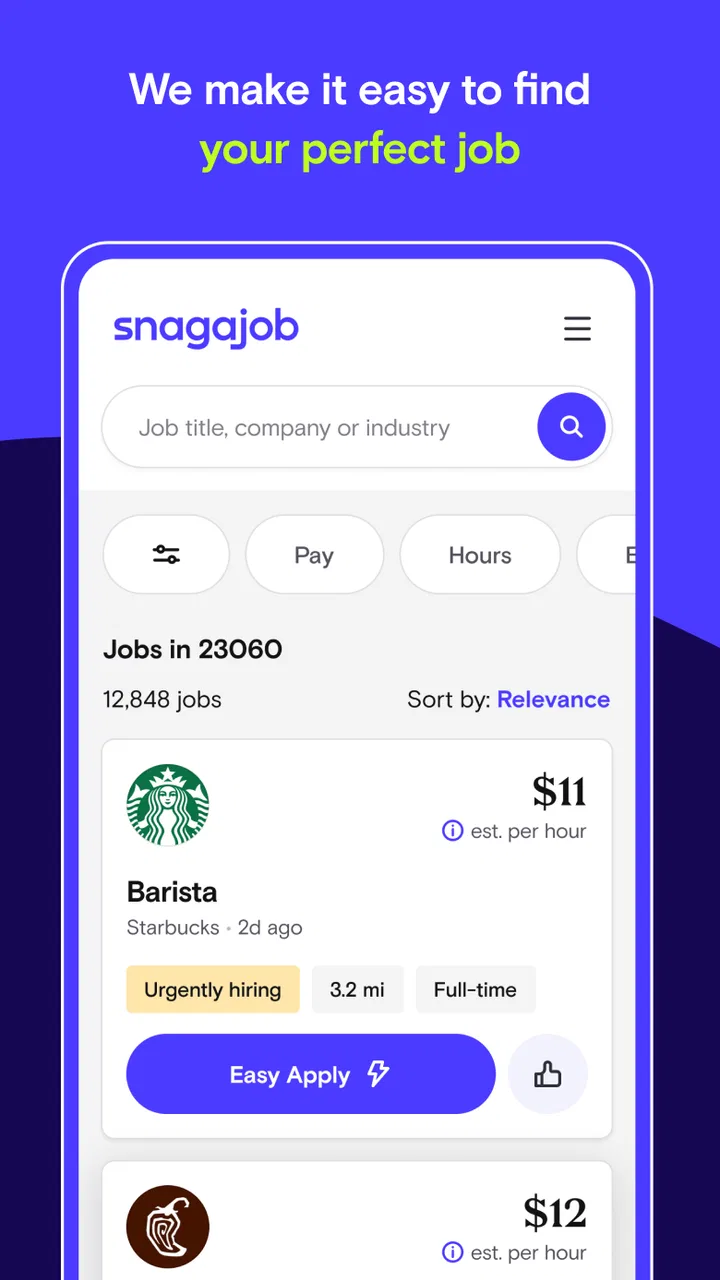
Snagajob - Jobs Hiring Now
- 3.7
- Rating
- 5.00M
- Installs
- Free
- Price

 Analysis by App-foxy
Finding hourly work is often less about discovering a perfect career path and more about solving a practical problem quickly: I need shifts, I need nearby options, and I need to know whether applying is worth my time. That is where Snagajob - Jobs Hiring Now fits. It is a free business app from Snagajob.com, Inc. focused on connecting people with flexible work in areas such as restaurants, retail, and hospitality.
I approached it as a tool for an ordinary job search rather than as a full career-management platform. That distinction matters. The app makes the most sense when you want hourly employment and need a mobile-first way to browse openings, compare possibilities, and move from searching to applying without sitting at a computer for hours. It is less convincing if your goal is highly specialized professional recruitment or a carefully planned long-term career transition.
Its current version is 7.0.11, it is free to use, and it is suitable for Everyone. The app has been available since May 10, 2013, and its reach is substantial, with over five million installs. A 3.9 average from around forty-one thousand ratings suggests a useful but not universally smooth experience, which matches my overall impression: the concept is practical, but the quality of a job-search session depends heavily on the listings available in your area and on how quickly you act.
You May Also Like

 Blood Strike: 2.5 Anniversary
Blood Strike’s Loadouts Turn Every Drop Into a Tactical Gamble
A close look at Blood Strike’s custom loadouts: how fast access to signature weapons reshapes its battle royale rhythm, rewards preparation, and narrows the gap between fights.

 Pandora - Music & Podcasts
Pandora’s Music Is Easy to Start, but Harder to Recover
Pandora’s strength is its low-effort path from a seed to a station. Its weak spot is how much confidence it asks you to place in connection, setup, and quiet recovery.

 8 Ball Pool
 Is Built on Rivalries, Rematches, and Routine
A close look at the rivalries, rematches, shared routines, and unanswered safety questions that turn a quick pool match into a persistent mobile community.

 Samsung Music
’s Quiet Strength Is Playing What You Already Own
Its reach comes less from spectacle than from dependable access to a personal library. That simplicity is both the app’s strongest retention engine and its ceiling.

 AccuWeather: Weather Radar
AccuWeather Review: A Quick, Clear Forecast for Everyday Decisions
For everyday plans, the best forecast is the one you can understand quickly. AccuWeather makes rain timing, radar, and local conditions easy to act on, with a few trade-offs.

 Hill Climb Racing
Why Hill Climb Racing Still Turns Crashes Into One More Run
A tiny car, a bumpy hill and one more upgrade: Hill Climb Racing keeps resurfacing because its simple chaos makes every near-miss feel personal.
More From Our News Desk



How the app feels during a real job search
I find the most useful way to approach this search is to decide what would make a shift workable before comparing openings. In the next section, I look at how a focused search can save time, while also explaining why a promising title is only the beginning of a good application decision.
Fast enough when the search is focused
My first impression is that Snagajob is built for short, purposeful sessions. I would not open it expecting to spend an entire evening browsing every possible employment category. It works better when I already know the kind of work I can accept, the distance I am willing to travel, and the schedule that fits my life.
That focus makes the experience feel faster even when the app itself is not doing anything remarkable. Searching around a specific location and job type is more useful than entering a vague phrase and scrolling through an enormous mixed collection. For someone looking for a restaurant shift, retail role, or hospitality position, the app’s central purpose is immediately understandable.
There is also a practical speed advantage in using a dedicated hourly-job service instead of general web searches. A standard search engine may return company pages, old advertisements, career articles, and unrelated results before showing an opening. Snagajob keeps the task centered on employment listings, so I spend less time filtering out information that does not help me apply.
Still, I would not treat every result as equally urgent or equally current. Job hunting rewards quick follow-up, but it also requires judgment. A listing can look suitable because the title is familiar while the schedule, location, or responsibilities are wrong for me. The app helps me find opportunities quickly; it does not remove the need to read each one carefully.
What happens when I use it heavily
The most demanding use case is not one search. It is a long session in which I repeatedly change locations, switch between restaurant and retail work, open many listings, and return to earlier results. That is when the app becomes more dependent on the quality of the network and the amount of information being loaded.
For a normal search, I would expect modest resource demands from a business app like this. Browsing job information is generally lighter than using a game, streaming video, or a navigation app. The heavier moments come from the workflow around the search: opening many postings, moving back and forth, reviewing details, and preparing several applications in one sitting.
My advice is to search in batches rather than constantly refreshing without a plan. I would first define a realistic radius, review the most promising openings, and make a short list of employers that match my availability. Then I would apply or follow up while the information is still fresh. This reduces unnecessary scrolling and makes the app feel more responsive because I am asking it to perform a clear task instead of treating it like an endless feed.
A second useful habit is to compare openings by schedule before comparing them by title. Hourly work can look attractive until the shifts conflict with school, another job, childcare, or transportation. Sorting my priorities this way prevents the app from encouraging a large number of low-value applications. The strongest use of Snagajob is not applying everywhere; it is narrowing the search to jobs I can realistically keep.
Stability and recovery during everyday use
Reliability matters more in a job app than in many casual apps because a failed session can interrupt an application at the worst moment. I expect a job search to involve interruptions: I may lose reception on a commute, switch to another app to check my calendar, or close the app before finishing. A useful service should let me return to the search without forcing me to reconstruct everything from memory.
In practical terms, I would treat Snagajob as a tool that benefits from a stable connection and deliberate handling. If a page takes longer than expected, I would avoid repeatedly tapping the same control. I would wait, return to the results, and reopen the listing once. That simple recovery approach is safer than assuming an application or search action completed just because the screen changed slowly.
I also recommend keeping a personal note of the positions I have already considered. Even a basic list containing the employer, role, location, and application status can prevent duplicate effort when I revisit the app later. This is one of the less obvious trade-offs: the app can centralize discovery, but I still benefit from maintaining my own lightweight tracking system instead of relying entirely on memory or a single session.
The rating of 3.9 from roughly nine thousand one hundred reviews tells me not to promise flawless stability or a perfect match between every user and every listing. I would install it because the job-search purpose is clear, not because I expect every interaction to be effortless. If the app behaves unpredictably on a particular phone, using the service at another time or checking the employer’s own application route may be sensible for an important opening.
Older phones and practical device limits
The minimum operating-system requirement is Android 5.0, which keeps the app accessible to people using older Android devices. That is relevant for hourly workers who may not replace a phone frequently. A lower entry requirement can make a job-search tool available to more people, especially those who need work but cannot justify buying a new device first.
At the same time, operating-system compatibility does not guarantee an identical experience on every phone. Older hardware may take longer when several listings are opened in succession, particularly if the device has limited free storage or many other apps running. I would close unnecessary apps before a serious application session and make sure the phone has enough battery to finish the process.
Screen size is another practical consideration. Reading job descriptions on a small display is possible, but it makes details easier to miss. I would pay special attention to shift times, travel distance, and any qualifications rather than relying on the job title alone. If a listing is important, I would reread it before sending an application, preferably when I am not rushing.
People using iPhones should also think about their preferred workflow. The app is positioned as a mobile job-search service, but the exact comfort of applying depends on the device and on how much information I need to enter. A phone is excellent for discovery and quick follow-up; a larger screen may still be more comfortable when I need to prepare detailed work history or compare several opportunities side by side.
Who gets the most value from it
Snagajob is a strong fit for someone who wants flexible, hourly work and is willing to search by practical factors rather than prestige. A student looking for shifts around classes, a parent seeking a schedule that fits family responsibilities, or someone trying to add a second source of income can all benefit from its focused employment category.
It is particularly useful when location matters. Restaurant, retail, and hospitality jobs are often chosen based on commute as much as on title, and a mobile search makes it easier to look while planning errands or checking whether an opportunity is realistic from home. I would use it to build a local shortlist, then investigate the employer and schedule before committing.
The app is also helpful for people returning to work who do not want to begin with a complicated professional-networking profile. General career platforms can feel oriented toward office roles, polished résumés, and long application processes. Snagajob’s hourly focus makes the first step less intimidating for someone whose immediate goal is dependable work rather than a major career rebrand.
However, I would skip it as my main search tool if I were pursuing senior professional positions, freelance contracts, highly technical roles, or jobs that depend on a portfolio and industry connections. In those cases, a specialized board, professional network, recruiter, or direct employer page may provide better context and stronger opportunities. Snagajob is not supposed to replace every employment channel.
How it compares with familiar alternatives
Compared with searching directly on individual company websites, Snagajob offers a more convenient starting point because I can look across hourly opportunities in one place. The trade-off is that a company’s own careers page may provide more background about workplace culture, benefits, advancement, and the full hiring process. I see Snagajob as the discovery layer, not always the final source of truth for deciding whether an employer suits me.
Compared with broad job boards, its narrower focus is both its advantage and its limitation. I spend less time filtering out unsuitable professional listings, but I also get less value if my target role falls outside restaurant, retail, hospitality, or similar hourly work. A general board is better when I want one account for many career levels and industries.
Compared with asking friends, walking into local businesses, or using community groups, the app provides more structure and makes it easier to search repeatedly. Personal recommendations can reveal workplace realities that a listing cannot, though, including management style, busy periods, and whether schedules are genuinely flexible. I would combine the app with local knowledge rather than using it in isolation.
One trade-off deserves special attention: convenience can encourage shallow applications. Because mobile searching is easy, I may be tempted to send applications to every nearby result. My better approach is to use the app for speed, then add human judgment through research, a tailored résumé, or a direct call when appropriate. That produces fewer but more realistic applications.
Small workflows that make the app more useful
My preferred workflow begins with a weekly availability check. Before searching, I write down the hours I can actually work, the maximum commute I can manage, and whether I need fixed shifts or can accept changing schedules. Then I search with those limits in mind. This avoids the common mistake of becoming interested in a role before noticing that its hours cannot work.
Another useful approach is to separate “apply now” from “investigate.” An opening with a clear schedule and manageable commute belongs in the first group. A listing with an appealing title but unclear timing belongs in the second. I would not spend the same effort on both. This simple division makes the app more efficient and protects time for applications that have a realistic chance of fitting my life.
I would also revisit searches at different times rather than assuming one session shows everything worth considering. Hourly hiring can change quickly, and a search that looks thin today may be more useful after employers update their openings. I am not treating that as a promise of new results; it is simply a sensible way to avoid making a decision based on one brief look.
For transportation-sensitive work, I would check the route independently before applying. A location that appears nearby may still be difficult without a car, outside public-transit hours, or expensive to reach during early or late shifts. The app can help me find the job, but my commute plan determines whether the job is sustainable.
Finally, I would prepare a concise résumé and a few accurate availability details before beginning. Mobile applications are easier when I am not composing everything under pressure. This is especially important for first-time hourly applicants: clear information about experience, schedule, and start date can be more useful than trying to sound overly formal.
Privacy, expectations, and application judgment
Any employment app deserves a careful approach because job hunting involves personal information. I would read each application step before submitting, confirm that the employer and role make sense, and avoid rushing through requests simply because I want to finish quickly. If a listing or message feels inconsistent with the job, I would pause and verify it through a trusted employer channel.
I would also keep expectations realistic. A listing is an invitation to apply, not a guarantee of an interview or a job offer. The app can reduce the friction of finding hourly openings, but it cannot control employer response times, selection decisions, or whether a position remains available by the time I apply. Treating it as one part of a broader search keeps disappointment from turning into an unfair judgment of the tool.
The free price is a meaningful strength for people who are already watching expenses. It removes a direct cost from the search and makes experimenting with the service low risk. Still, “free” does not mean the process costs nothing: my time, transportation, data use, and application effort remain valuable. I would judge each opportunity by the likely fit, not merely by how easy it is to tap through.
My performance verdict
After looking at speed, heavier search sessions, recovery, and device practicality, I see Snagajob as a focused and accessible tool rather than a complete employment solution. It is at its best when I need nearby hourly work, want to search from a phone, and can make decisions based on schedule and commute. The modest resource expectations are appropriate for this kind of app, while older Android support makes it more approachable for people with aging devices.
The main limitations are equally clear. A mobile interface cannot replace careful reading, personal record-keeping, employer research, or a backup search method. Results may be less useful outside hourly industries, and a convenient application flow can tempt me to apply without checking whether the job truly fits. Users who need specialized careers, detailed employer comparisons, or advanced professional networking should look elsewhere or use this only as a secondary channel.
Overall, I would recommend trying it if your immediate goal is flexible work in restaurant, retail, hospitality, or related hourly settings. Its 5M+ installs show that it has reached a large audience, while its 3.9 average indicates that I should approach it with practical expectations rather than assuming a perfect experience. The best reason to use Snagajob is not that it promises a job; it is that it can make the first, most time-consuming search step more manageable.
If I were recommending it to a friend, I would say: install it, define your availability before searching, compare the commute as carefully as the pay or title, and keep notes on every serious application. Used that way, Snagajob - Jobs Hiring Now is a sensible free companion for an active hourly job search, especially when speed and local flexibility matter more than a polished long-term career platform.
FAQs for Snagajob - Jobs Hiring Now
01What is Snagajob, and how does it work?
Snagajob is a job search app that connects job seekers with hourly work opportunities. Users can browse job listings, filter by location and industry, and apply directly through the app. Employers post jobs, and the app helps match them with potential candidates. It’s designed to streamline the hiring process for both sides.
02Is Snagajob free to use, or are there any hidden fees?
Snagajob is free for job seekers to use. You can search for jobs, apply to positions, and create a profile at no cost. Employers, on the other hand, may pay for premium features to enhance their job postings and reach more candidates. Be assured, job seekers won’t encounter any hidden fees.
03How reliable are the job postings on Snagajob?
Snagajob works to ensure that job postings are legitimate and up-to-date. However, like any job platform, it’s important for users to do their due diligence. Check company reviews, verify details directly with the employer, and be cautious of any job offer that seems too good to be true. This will help ensure a safe job search experience.
04Can I apply to jobs directly through the Snagajob app?
Yes, you can apply to jobs directly through the Snagajob app. The app allows you to create a profile, upload your resume, and apply to positions with just a few taps. Some jobs may require additional information or a separate application process, but most can be applied to directly within the app.
05Does Snagajob offer any resources to help improve my job search?
Snagajob provides various resources to assist users in their job search. These include tips on resume building, interview preparation, and career advice articles. The app aims to equip job seekers with the tools and knowledge needed to increase their chances of landing the right job.
Pros
- User-friendly interface for quick navigation.
- Large database of job listings available.
- Customizable job alerts for user preferences.
- Easy application process with one-click apply.
- Includes company reviews for better insights.
Cons
- Limited advanced search filters available.
- Some listings may be outdated or inaccurate.
- Frequent ads can disrupt user experience.
- Requires account creation for full features.
- No direct communication with employers.

Snagajob - Jobs Hiring Now
Gallery